Here is the assignment. It does not look pretty. The one I gave looked much better!
I spent two years of college being an RA. I hung streamers from the ceiling for several holidays. I stole it from Andrea, the 6th floor RA!
I honestly can't believe it took me SO long to think of it. During my 8th year of teaching I decided that I really should (and academically, could) decorate the hallway. It was last minute, so my tinsel options were limited.
I figured out how much tinsel I needed and how much was available at the local store (in two colors).
It was mostly estimation. It was below the level for most students, but I still think it was good for all of them.
I loved it because it made the halls festive!
I think next year I am going to get Christmas themed scrapbook paper and cut 1-inch strips so the kids can make paper chains and hang them from the ceiling.
Showing posts with label activity. Show all posts
Monday, July 17, 2017
Christmas Lights
Here is my file. It doesn't look as good as the Excel file I made, but I this is how it looks when I upload it here. : /
I had kind of last-minute inspiration to do something Christmas-related at school.
I decided to do the 'estimation' activity and then I included a few other tasks in this assignment.
I got a ton of ribbon, but I guess I can do this again next year with the leftovers.
When we were done, I told the kids, "Uhh... We are not actually going to hang these." Some of them were sad or disappointed or indignant. I decided they had a point. I have two beams going across my room with lights. (It is a really high ceiling above that.) We hung the streamers across those two beams. They were long enough they just hung there.
It did not end up being very pretty. The colors were kind of strange and one of my students mentioned that it looked like the bad decorations of a gender-reveal party!
They were fun for a couple days, but we took them down quick.
I still want them to think even when they get a little antsy for holidays. Also, I don't like to do this right before finals. I like to do 'real' math then.
I drilled holes in the cups. (My dad helped a lot. Dads are the best!) The kids pushed the balloon through the hole and then blew up the balloon.
Factors and Feathers
Here is the template and worksheet I assigned.
I do this to have some Thanksgiving decorations. It is also a good time to review in Geometry and Advanced Algebra & Trigonometry. It is a little below the level for College Algebra or Calculus.
I first gave the students two columns on a paper and had them
1.) Write the polynomial
2.) Write all of the possible factors of c
3.) Write the factors of the polynomial
4.) Write the solutions to the polynomial.
Then I had them trade with a person and check.
When everything is correct, then they got a half of a paint sample and they used a marker to write each thing.
I found a turkey clip art and just followed it. It was a lot of cutting out. My mom helped me. (Moms are the best!)
I took the pretty ones and put them together to make a turkey. I tried to put the 'similar color palette' cards together.
Saturday, January 16, 2016
City Map - Parallel Lines Cut by A Transversal
I found this idea a long time ago. It's on Wikispaces.

I really liked it and have had my students do it two years now. I altered it a little.

They are more creative than I am, so I try not to restrict them too much.
I give this a little after they learn about parallel lines cut by a transversal. It's not completely new to them, but some do struggle a little with where each of the buildings should go. I tell them to make a fake map on a smaller paper before they draw it on the big one.

I do not require them to make large, good-looking buildings. I know that many of them have much better maps if they're allowed to make simple figures. If I was the student, that's the position I would be in.

I also hang the prettiest ones on the wall in the hallway, as long as most of their locations are correct!

One map had Mike Wazowski Rd and other animated street names. Some of them like to have themes, but many of them are pretty standard.
One maps had This Street, That Street, Which Street, Where Street, and There Street, etc. That may be my favorite!
The two intersecting lines don't have to be parallel, but it's easier if they are!
Monday, January 4, 2016
Your Name Here - Midpoints
Just like the "Thankful" words and the "Character" words activities, I have a Name-Activity where students calculate midpoints.

Actually, I think for the College Algebra class, they calculate distance, but it makes no difference.
When I do the Name, Character, and Thankful activities, one of them is for slope, one is for distance, and one is for midpoint. I usually do the name first, and I do them in the order of Lesson number.
That's all with my Geometry students.
With the College Algebra students, I 'have' to cover the distance formula. It's probably something I should just skip, but I don't like skipping things, so we do this instead.

With the Thankful and Character activities, I usually don't hang up each word. I try to not get too many repeats and I only pick the ones that are neat, colored, and look good.
With the Names activity, I hang every single one up.
I keep the same requirements for each of these assignments:
*Every letter must have only straight line segments. No curves!
*Every segment must have a slope that is not zero or undefined. (No horizontal or vertical lines.)
*Every word must be drawn in something other than pencil.
Sometimes, this may be a challenge.
Some students decide they don't like the way the name looks, so they redo several letters just to improve one.
**Generally, this activity is easier to do with all-capital letters.
**Sometimes letters can be a little tricky to make w/o vertical or horizontal lines. These can be done by placing the letters at an angle and/or drawing them 'artistically.'
For these projects, the kids have to show work.
That work must include calculations with the ordered pairs. (That is the entire point of this project.)
It has to be organized!
The name has to be at least 4 letters long.

Actually, I think for the College Algebra class, they calculate distance, but it makes no difference.
When I do the Name, Character, and Thankful activities, one of them is for slope, one is for distance, and one is for midpoint. I usually do the name first, and I do them in the order of Lesson number.
That's all with my Geometry students.
With the College Algebra students, I 'have' to cover the distance formula. It's probably something I should just skip, but I don't like skipping things, so we do this instead.

With the Thankful and Character activities, I usually don't hang up each word. I try to not get too many repeats and I only pick the ones that are neat, colored, and look good.
With the Names activity, I hang every single one up.
I keep the same requirements for each of these assignments:
*Every letter must have only straight line segments. No curves!
*Every segment must have a slope that is not zero or undefined. (No horizontal or vertical lines.)
*Every word must be drawn in something other than pencil.
Sometimes, this may be a challenge.
![]() |
| That is a "U." |
Some students decide they don't like the way the name looks, so they redo several letters just to improve one.
**Generally, this activity is easier to do with all-capital letters.
**Sometimes letters can be a little tricky to make w/o vertical or horizontal lines. These can be done by placing the letters at an angle and/or drawing them 'artistically.'
For these projects, the kids have to show work.
That work must include calculations with the ordered pairs. (That is the entire point of this project.)
It has to be organized!
The name has to be at least 4 letters long.
Sunday, January 3, 2016
King Frostine Wages War
I'm very proud of this. I wrote it a couple years ago during finals. Finals are boring! I had only done one lesson of this 3-lesson unit. I was getting ready to do the rest when we came back from break in January.
I made up the story, but not the names or 'races.' Don't sue me. I'm not making money off of this!
Geometry, "Center" of a Triangle, a Task from King Frostine
You live in the land of Sunderedcounter in Intermedio Tierra where King Frostine rules over all of the Lilliputians. You are the king's head mathematician.
![]() |
| John Hurt's voice |
There is some disarray in the land. King Frostine is ready to wage war with three nearby cities Crystalgarth, Sunderfen, and Sharpetide. His plan is to use catapults to continuously launch water balloons at each city until they surrender.
The assault will go fine as long as the liliputians have access to a camp nearby.
King Frostine only has enough resources to set up only one camp as a refilling station.
King Frostine must pick the location of his camp very carefully. The camp must be exactly the same distance away from each Crystalgarth, Sunderfen, and Sharpetide.
The reasons for this are political. King Frostine's biggest supporters, Lemel Hailglow, Hazel Flameshimmer, and Bracken Goldtree, each prefer he focus on a different city.
Lemel wants to attack Crystalgarth. The mermaids from Crystalgarth are always singing limericks about the liliputians right outside Lemel's house.
Hazel wants to attack Sunderfen. The dragons of Sunderfen are always dropping jello-filled water balloons onto Hazel's daisies.
Bracken wants to attack Sharpetide. The centaurs of Sharpetide are always stealilng Bracken's pumpkins.
King Frostine must pick a location that is equidistant to each so he isn't showing any favoritism.
He needs your help. You have taken a map of Intermedio Tierra and connected Crystalgarth, Sunderfen, and Sharpetide. This has created a triangle.
King Frostine set each of your apprentices Brelynd, Jarthan, Tolbain, and Camnar the task to determine where the camp should be located.
Brelynd thinks we should locate it at the centroid.
Jarthan thinks we should locate it at the orthocenter.
Tolbain thinks we should locate it at the incenter.
Camnar thinks we should locate it at the circumcenter.
Which place should we locate the camp of water balloon refills?
Use geometry vocabulary to explain this.
If you're not a math teacher, then you can stop reading here!
The following pages contain a map of Intermedio Tierra.
Calculate the distance from the camp to each of the
cities.
Brelynd thinks we should
put the camp at the centroid. Use this
graph to locate the location (ordered pair) of the centroid. Be sure to label the midpoint of each side of
the triangle. Use a ruler to draw the
medians. Graph the centroid on the map.
Jarthan thinks we should
put the camp at the orthocenter. Use
this graph to locate the location (ordered pair) of the orthocenter. Use a ruler to make a (GOOD) sketch of each altitude. Remember altitudes are perpendicular, and
should be labeled as such. Make a (GOOD)
estimate of where the orthocenter is located. Label the orthocenter on the map.
Tolbain thinks we should
put the camp at the incenter. Use this
graph to locate the location (ordered pair) of the incenter. Use a compass and a straight-edge to
construct each angle bisector. Remember
to label the angles as bisected. Make a
(GOOD) estimate of where the incenter is located. Label the incenter on the
map.
Camnar thinks we should put
the camp at the circumcenter. Use this
graph to locate the location (ordered pair) of the circumcenter. Use a straight-edge to sketch each perpendicular
bisector. Remember to label the sides as
bisected. Determine where the circumcenter
is located. Label the circumcenter on the map.
I put the same graph paper map on each page.
It's easiest if you use a right triangle.
Saturday, January 2, 2016
Hexaflexagons
I actually found a copy of my old post on Hexaflexagons!
So... the 'dates' are a little off.
Last spring I attended the NCTM national conference in Denver. I attended some really great sessions. The last one was the finale with George and Vi Hart. They are what I like to call “recreational mathematicians.” You know… because that’s a thing! After seeing some of Vi’s videos, I was interested.

Later, I decided I wanted to do the hexaflexagons in school. It was her idea, really. We had a hexaflexagon party on Martin Gardner’s birthday. He was the ‘original recreational mathematician.’ His birthday is October 21, so I put it on iCal, and waited for the day to come. I showed Vi’s videos Hexaflexagons, Hexaflexagons 2, Hexaflexagon Safety Guide, and Hexaflexamexagon- I think that’s the one that hooked me originally! I printed off the hexaflexagon template. I told the kids to be sure to make good creases! They created their tri-hexaflexagons, decorated them, and a few even tried the hexa-hexaflexagon.
Truthfully, I have not figured out the
hexa-hexaflexagon. In due time. … I’m
getting better at the tri-hexaflexagon.
One class (out of 6) I had a tough time with the tri-hexaflexagon. I finally got it to fold the correct way and
it was the very end of class. I decided
to go ahead and let them finish it the next day, but we didn’t need to spend an
entire class on it. So I came up with a
little research worksheet. To ensure
they didn’t use Wikipedia, I made them ‘cite’ their sources.
I thought it was pretty cool and the kids liked it. It makes math fun again- at least a little!
I made them color some design to show that when you 'flex' it, the design changes.
This year, I made my own template. It wasn't too difficult, but it worked the best. It was not perfect, but if you made the creases well, then you could make a hexaflexagon.
Broncs are... Broncs Value... Broncs Have...
I like to use half- sheets of 8.5X11 grid paper.
It's usually large enough to fit one word. (When it's not, then the kids add another paper, or part of another paper to the end.)
The student draws his or her name on the paper. Then he or she calculates the midpoint of each segment.
The student draws a (pre-approved) word on the paper. Then he or she calculates the slope of each segment.
The student draws a (pre-approved) word on the paper. Then he or she calculates the distance of each segment.
The student draws a (pre-approved) word on the paper in block letters. Then he or she calculates the perimeter and area of each composite figure.
The pre-approved word usually has a theme.
This time the theme was positive characteristics.
I made a sign for each category. They said:
Broncs are...
Broncs Value...
Broncs Have...
then I split up the words so they would sound correct grammatically.
I used purple for the backgrounds of my signs because it's one of our school colors.
For this to work, the kids had to follow these guidelines:
*Every letter must have only straight line segments. No curves!
*Every segment must have a slope that is not zero or undefined. (No horizontal or vertical lines.)
*Every word must be drawn in something other than pencil.
**Generally, this activity is easier to do with all-capital letters.
**Sometimes letters can be a little tricky to make w/o vertical or horizontal lines. These can be done by placing the letters at an angle and/or drawing them 'artistically.'
For these projects, the kids have to show work.
That work must include calculations with the ordered pairs. (That is the entire point of this project.)
It has to be organized!
I tried to come up with several, various, long words. If the kids come up with an alternative, they can use it as long as I approve of it. I usually go for at least 6 or 7 letters:
For the Characteristics Activity, the list I gave them was:
I would put Sincere, Credible, or Accurate
in the Broncs are... category
I would put Kindness
in the Broncs Value... category
I could put
Integrity or Decorum
in both the Broncs Have... or Broncs Value... categories
with several repeat words, that was a good way to decorate

Check out my Thankful Activity. It's similar, but this time they calculate distance.
Check out my Name Activity. It's similar, but this time they calculate midpoints.
It's usually large enough to fit one word. (When it's not, then the kids add another paper, or part of another paper to the end.)
The student draws his or her name on the paper. Then he or she calculates the midpoint of each segment.
The student draws a (pre-approved) word on the paper. Then he or she calculates the slope of each segment.
The student draws a (pre-approved) word on the paper. Then he or she calculates the distance of each segment.
The student draws a (pre-approved) word on the paper in block letters. Then he or she calculates the perimeter and area of each composite figure.
The pre-approved word usually has a theme.
This time the theme was positive characteristics.
I made a sign for each category. They said:
Broncs are...
Broncs Value...
Broncs Have...
then I split up the words so they would sound correct grammatically.
I used purple for the backgrounds of my signs because it's one of our school colors.
For this to work, the kids had to follow these guidelines:
*Every letter must have only straight line segments. No curves!
*Every segment must have a slope that is not zero or undefined. (No horizontal or vertical lines.)
*Every word must be drawn in something other than pencil.
**Generally, this activity is easier to do with all-capital letters.
**Sometimes letters can be a little tricky to make w/o vertical or horizontal lines. These can be done by placing the letters at an angle and/or drawing them 'artistically.'
For these projects, the kids have to show work.
That work must include calculations with the ordered pairs. (That is the entire point of this project.)
It has to be organized!
I tried to come up with several, various, long words. If the kids come up with an alternative, they can use it as long as I approve of it. I usually go for at least 6 or 7 letters:
For the Characteristics Activity, the list I gave them was:
| ACCURATE | CHARACTER | CREDIBLE | ENDURANCE | |||||
| ATTENTIVE | CIVILITY | DARING | ETHICAL | |||||
| AUTHENTIC | COURAGE | DECORUM | ETIQUETTE | |||||
| BRAVERY | COURTESY | DIGNITY | FAITHFUL | |||||
| DISCIPLINE | GENUINE | |||||||
| GOODNESS | ||||||||
| KINDNESS | RIGHTEOUS | |||||||
| GRACIOUS | ||||||||
| OBJECTIVE | SINCERE | |||||||
| HONESTY | ||||||||
| PATIENT | STAMINA | |||||||
| HONORABLE | ||||||||
| PERSEVERE | TOLERANT | |||||||
| INTEGRITY | ||||||||
| POLITENESS | VIRTUOUS |
I would put Sincere, Credible, or Accurate
in the Broncs are... category
I would put Kindness
in the Broncs Value... category
I could put
Integrity or Decorum
in both the Broncs Have... or Broncs Value... categories
with several repeat words, that was a good way to decorate

Check out my Thankful Activity. It's similar, but this time they calculate distance.
Check out my Name Activity. It's similar, but this time they calculate midpoints.
![]() | ||||||||
We are Thankful for...
I like to use half- sheets of 8.5X11 grid paper.
It's usually large enough to fit one word. (When it's not, then the kids add another paper, or part of another paper to the end.)

The student draws his or her name on the paper. Then he or she calculates the midpoint of each segment.
The student draws a (pre-approved) word on the paper. Then he or she calculates the slope of each segment.
The student draws a (pre-approved) word on the paper. Then he or she calculates the distance of each segment.
The student draws a (pre-approved) word on the paper in block letters. Then he or she calculates the perimeter and area of each composite figure.


The pre-approved word usually has a theme.
This time the theme was things we are thankful for.
The composite figures happen around January/February, so the theme is things we love.
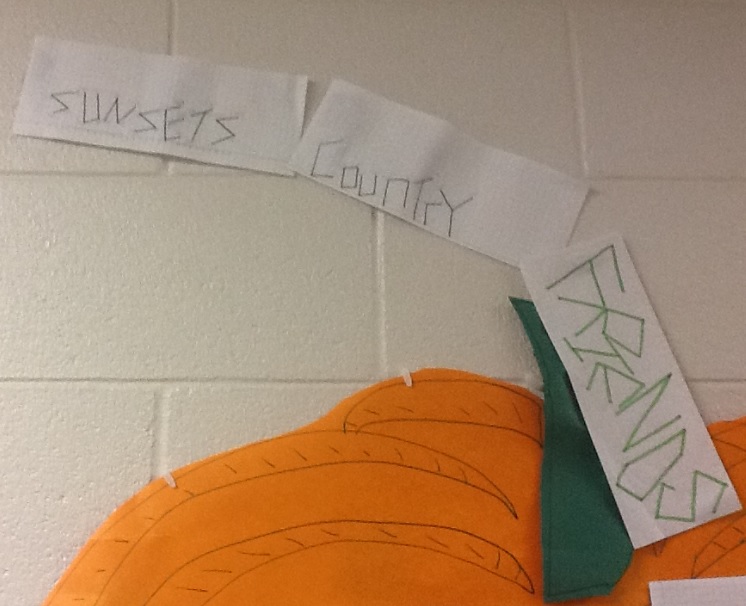
To help fit the theme, I offer extra credit when certain colors are used. For the things we love, I recommended that they use red, pink, orange, or purple. Then I taped them on the wall in a heart design.
I didn't think I would be able to succeed again with a pumpkin shape, so I cheated. I used my projector to draw a pumpkin shape, and then just put the words in the color-appropriate place.
For the thankful theme, I recommended they use orange, brown, or green.

Some kids used a mixture, but that didn't really help my wall-picture. Next time I will need to emphasize: orange OR brown OR green!
I did use those words, off to the side. I didn't get a clear picture of them though.
Last year when I did the Things We Love, there were some repeats, and I left them off.
I used purple because it's one of our school colors.
For this to work, the kids had to follow these guidelines:
*Every letter must have only straight line segments. No curves!
*Every segment must have a slope that is not zero or undefined. (No horizontal or vertical lines.)
**Generally, this activity is easier to do with all-capital letters.
**Sometimes letters can be a little tricky to make w/o vertical or horizontal lines. These can be done by placing the letters at an angle and/or drawing them 'artistically.'
For these projects, the kids have to show work.
That work must include calculations with the ordered pairs. (That is the entire point of this project.)
It has to be organized!
I tried to come up with several, various, long words. If the kids come up with an alternative, they can use it as long as I approve of it. I usually go for at least 6 or 7 letters:
For the Thankful activity, the list I gave them was:
Check out my Characteristics Activity. It's similar, but here they calculate slope.
Check out my Name Activity. It's similar, but here they calculate midpoints.
It's usually large enough to fit one word. (When it's not, then the kids add another paper, or part of another paper to the end.)

The student draws his or her name on the paper. Then he or she calculates the midpoint of each segment.
The student draws a (pre-approved) word on the paper. Then he or she calculates the slope of each segment.
The student draws a (pre-approved) word on the paper. Then he or she calculates the distance of each segment.
The student draws a (pre-approved) word on the paper in block letters. Then he or she calculates the perimeter and area of each composite figure.


The pre-approved word usually has a theme.
This time the theme was things we are thankful for.
The composite figures happen around January/February, so the theme is things we love.
To help fit the theme, I offer extra credit when certain colors are used. For the things we love, I recommended that they use red, pink, orange, or purple. Then I taped them on the wall in a heart design.
I didn't think I would be able to succeed again with a pumpkin shape, so I cheated. I used my projector to draw a pumpkin shape, and then just put the words in the color-appropriate place.
For the thankful theme, I recommended they use orange, brown, or green.

Some kids used a mixture, but that didn't really help my wall-picture. Next time I will need to emphasize: orange OR brown OR green!
I did use those words, off to the side. I didn't get a clear picture of them though.
Last year when I did the Things We Love, there were some repeats, and I left them off.
I used purple because it's one of our school colors.
For this to work, the kids had to follow these guidelines:
*Every letter must have only straight line segments. No curves!
*Every segment must have a slope that is not zero or undefined. (No horizontal or vertical lines.)
**Generally, this activity is easier to do with all-capital letters.
**Sometimes letters can be a little tricky to make w/o vertical or horizontal lines. These can be done by placing the letters at an angle and/or drawing them 'artistically.'
For these projects, the kids have to show work.
That work must include calculations with the ordered pairs. (That is the entire point of this project.)
It has to be organized!
I tried to come up with several, various, long words. If the kids come up with an alternative, they can use it as long as I approve of it. I usually go for at least 6 or 7 letters:
For the Thankful activity, the list I gave them was:
| BREATHING | CAMPFIRES | CELLULAR | ||||||
| ABILITY | FRIENDS | |||||||
| CLOTHING | CHILDREN | EDUCATION | ||||||
| CHALLENGES | HOLIDAYS | |||||||
| EYESIGHT | FREEDOM | ELECTRICITY | ||||||
| LEARNING | MOUNTAINS | |||||||
| GROCERIES | OPPORTUNITY | EMPLOYMENT | ||||||
| READING | SUNSETS | |||||||
| HEARING | RAINBOWS | INTERNET | ||||||
| SECURITY | SUNSHINE | |||||||
| MEDICINE | AFFECTION | PLUMBING | ||||||
| SLEEPING | VACATIONS | |||||||
| MILITARY | DEVOTION | SAVINGS | ||||||
| WISDOM | WEEKENDS | |||||||
| VACCINES | KINDNESS | VEHICLE | ||||||
| DIVERSITY | LAUGHTER |
Check out my Characteristics Activity. It's similar, but here they calculate slope.
Check out my Name Activity. It's similar, but here they calculate midpoints.
Subscribe to:
Posts (Atom)